Format guide
7 entries: schedule and organizer notes
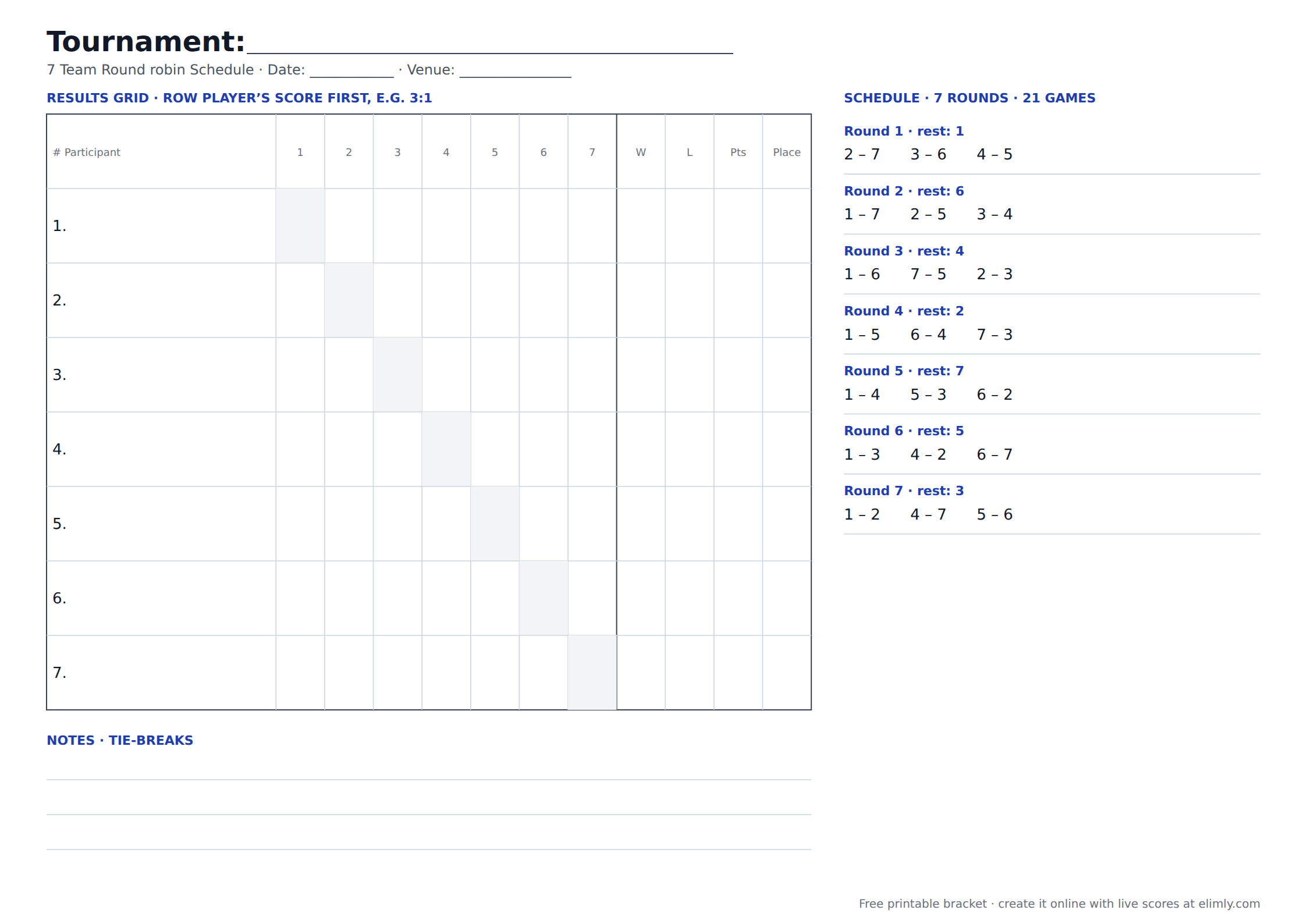
Seven teams need twenty-one games to meet every opponent once. With an odd field, each of the seven rounds has three games and one team resting, so the schedule needs seven rounds even though each team plays only six games.
- Single / double games
- 21 / 42
- Single / double rounds
- 7 / 14
- Games per entry (single)
- 6
- Resting entries per round
- 1
Every team sits out exactly one round
An odd number of entrants cannot all play at once. The generator adds a rotating rest slot, so each round pairs six teams into three games and leaves the seventh free. Over seven rounds every team rests once and plays its six opponents, which keeps the workload equal.
Tell teams which round they rest before the event, especially at a single venue where an idle team may leave between games. The preview below lists the resting team for every round next to the three pairings, using the same rotation your tournament will use.
Planning time and courts for twenty-one games
Three playing areas let a full round run together, which gives seven waves for the whole event. With two areas, a round needs two waves, so allow for fourteen time slots. A one-day event works best when games are short; otherwise spread the rounds across several dates.
Choose Double round robin for forty-two games in fourteen rounds. Each team then plays twelve games and rests twice, meeting every opponent home and away with positions reversed in the second cycle. Both cycles feed one standings table.
Frequently asked questions
How many games does a seven-team round robin have?
Twenty-one: 7 × 6 ÷ 2. They are arranged as three games in each of seven rounds, and each team plays six of them.
Why are there seven rounds and not six?
With seven teams one team must rest in every round. Seven rounds let each team rest exactly once while still meeting all six opponents.
Ready to build the bracket? Your settings above are still available.
Back to generator